
Autism Service Dogs in Sacramento
Trained Dogs That Help a Child Hold Steady in Public
The hardest part of an autism diagnosis, for a lot of the families who call us, is not the diagnosis. It’s the shrinking. The stores you stop going into, the birthday parties you decline, the evening routine that has to be identical or the night falls apart — the world gets smaller one avoided place at a time. A trained dog widens it back. Not by magic and not overnight, but by giving a child something predictable to hold onto in rooms that are otherwise unpredictable.
Quick Takeaways
- Who the handler is: Any individual on the ASD spectrum—children or adults. The applicant (or parent) submits the application, while our team directly handles all professional dog training.
- What the dog is trained to do: interrupt a repetitive or escalating behavior, sit as a physical buffer in a crowd, alert to rising anxiety, and travel to school as a working dog.
- Sleep is on the list: “Improve your sleep” is one of the needs the application asks about by name.
- ADA access follows the task: A dog trained to do a job for a disability has public access rights. A dog that is simply calming does not.
- Nobody has to prove it: No certificate, no registry, no vest. Staff may ask two questions and nothing more.
Autism Is Common. A Trained Autism Dog Is Not.
CDC’s ADDM Network estimates that about 1 in 31 children aged 8 has been identified with autism spectrum disorder, roughly 3.2%, in figures published in May 2025. Boys are identified more than three times as often as girls.
Now set that against how a task-trained dog gets made. One dog at a time, one repetition at a time, in every environment it will later have to hold together in.
So we don’t promise anyone a dog before we’ve read their application. The match either fits or it doesn’t.
What the Dog Actually Does During the Day
A school morning is a good test case, because it contains most of the tasks in sequence.
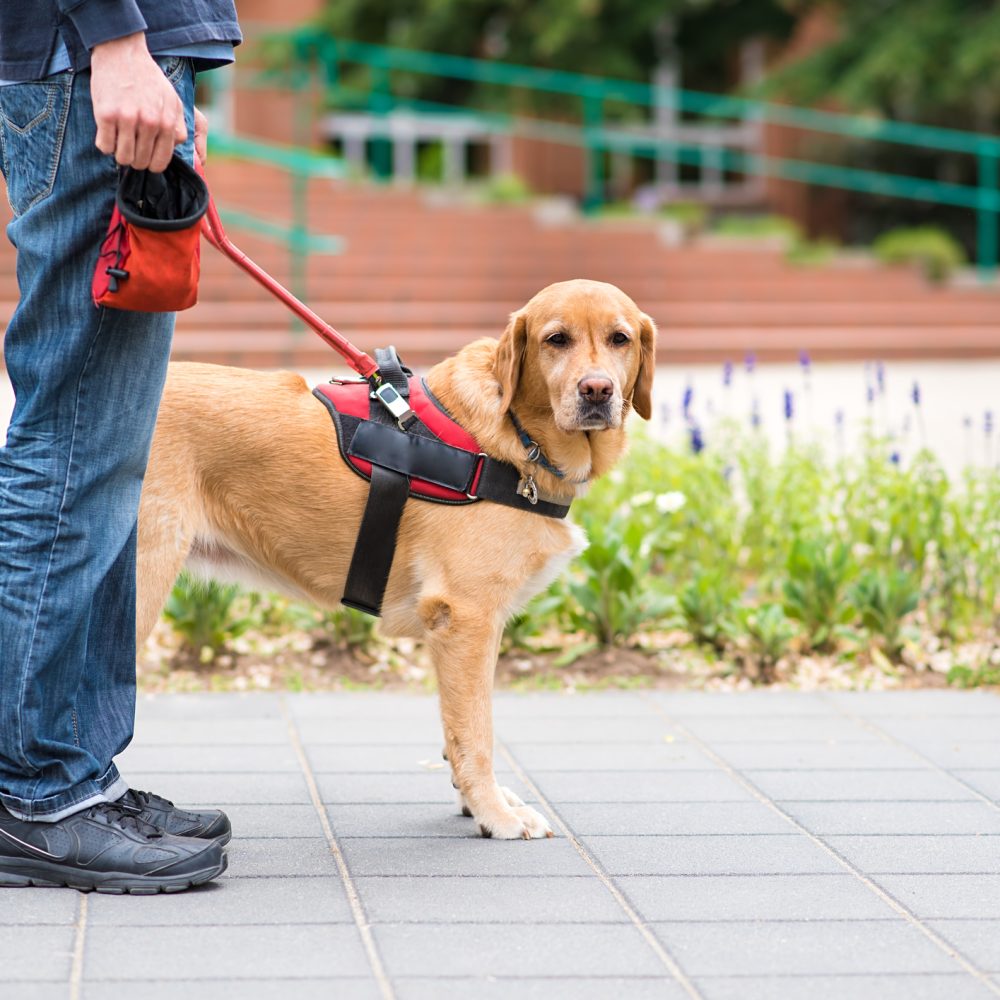
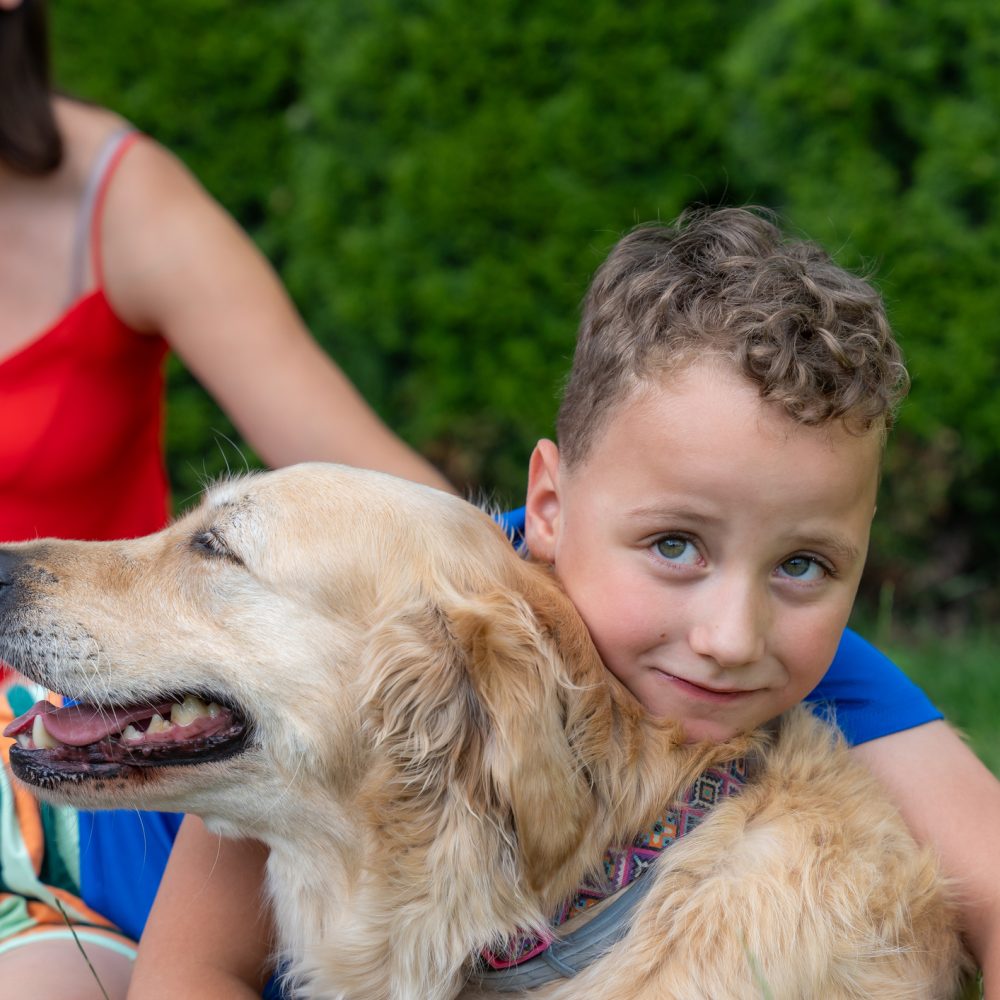
Getting out the door, the dog is a routine anchor — same dog, same harness, same order of operations, every single day. In the car and the drop-off line it works as a soft barrier, taking up the space where a stranger would otherwise be standing too close. If the child starts cycling — rocking, picking, repeating — the dog is trained to interrupt with a nose or a paw and reset the loop before it runs away.
And it reads the early signals. The breathing change, the stillness, the thing you’d have missed from the front seat.
Public Access Is the Part Families Underestimate
Everyone focuses on the tasks. The tasks are the easy half.
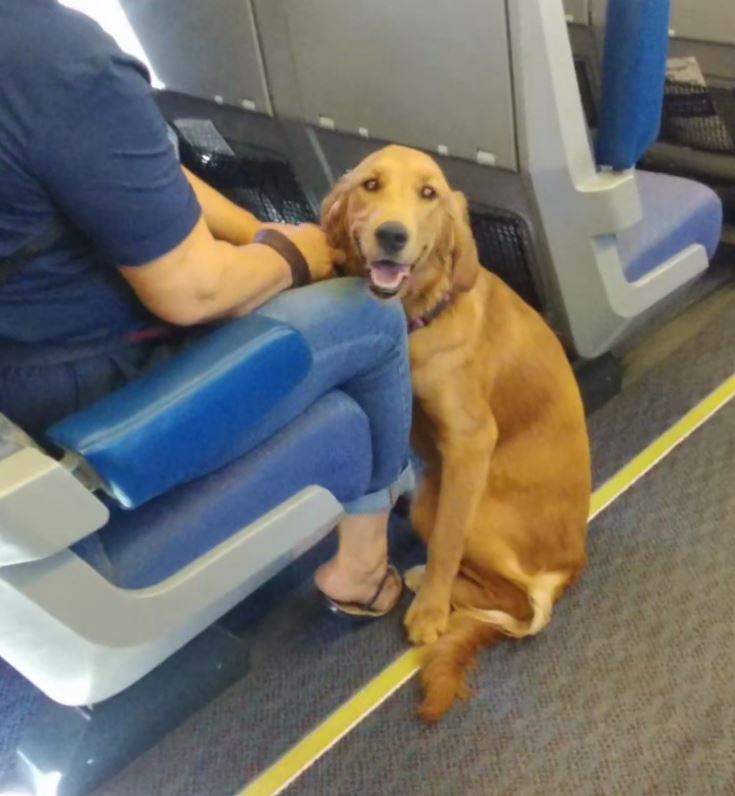
The hard half is a dog that will lie under a cafeteria table for forty minutes with food on the floor, ride a light rail car that lurches, ignore a toddler who grabs an ear, and do all of it while nobody is watching it closely. That is built slowly, in real places, with real distractions — not on a training field.
Spice is photographed working on a public train. That image is the standard, not a highlight reel.
No Corrections, and Especially Not on This Dog
Some trainers still build reliability out of discomfort — a startle, a pinch, a raised voice. We don’t, anywhere, but it matters most here. A dog trained through pressure learns to shut down when it’s stressed, and shutting down is the exact opposite of what you need from an animal whose job is to notice a child’s stress and act on it.
Everything is built the other way. Mark the right thing, pay for it, repeat until it’s boring.
The Family Trains Too, Not Just the Child
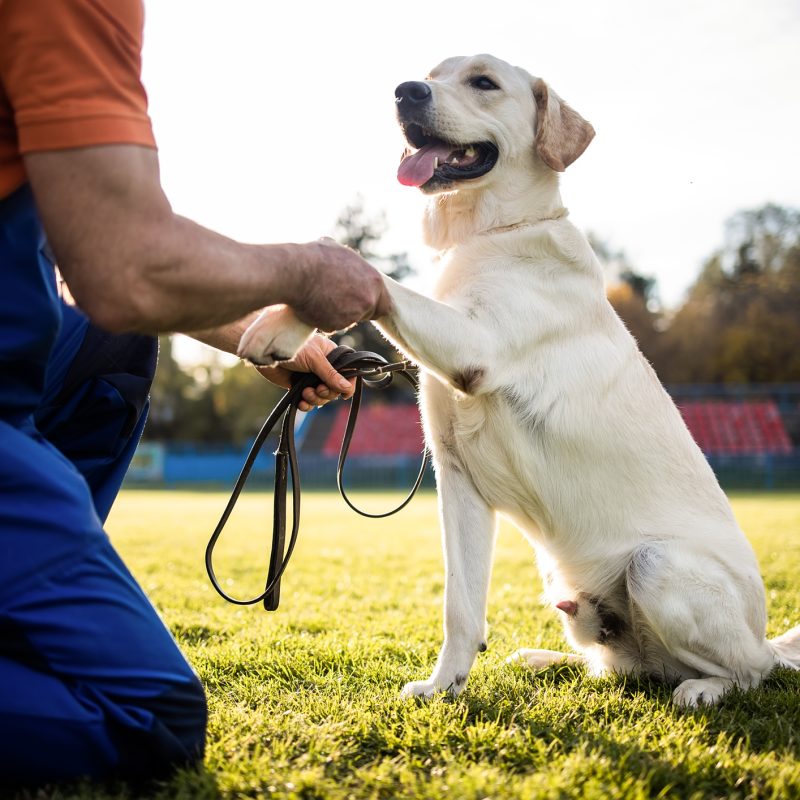
We ask on the application who else in the house will help care for the dog, and the answer changes what we recommend. A dog placed with a child is really placed with a household — siblings who feed it treats off-cue, a grandparent who lets it up on the couch, a parent whose timing is a half-second late. Any one of those can unpick months of work.
This is where the progress footage earns its keep. You cannot read your way into good handling. You watch your own dog work, you see the exact beat where the reward landed, and you copy it.
Frequently Asked Questions
What is the difference between an autism service dog and an emotional support dog?
A service dog is trained to perform specific tasks tied to the disability — interrupting a behavior, buffering a crowd, alerting to anxiety. An emotional support dog provides comfort by being present, which the ADA does not count as a task. Only the service dog carries public access rights.
Can a child be the handler of a service dog?
Yes, though in practice the dog is placed with the family and an adult carries most of the handling responsibility, especially early on. Our application asks directly about the age of the person who needs the dog and who else will help care for it.
Does an autism service dog need to be certified or registered?
No. The ADA does not require certification, registration, professional training programs, vests or ID cards. Sites that sell service dog registration are selling a document with no legal weight.
Can the dog go to school with my child?
Public access under the ADA follows the trained task, and traveling to school is one of the needs families name on our application. Schools have their own process, so start that conversation early rather than on the first morning.
What diagnoses do you accept for a service dog application?
Autism, PTSD, anxiety disorder, bipolar disorder and medical disability, documented by a physician.
Start With the Application
Tell us about your child, your household and the days that go badly. That’s the part we actually read.
Training with YES · Sacramento, California · trainingwithyes.com